
Premium Fastener Solutions for Diverse Applications

Hoonly delivers premium-grade fasteners that power industries worldwide. From corrosion-resistant stainless steel screws and dependable nuts and washers to robust self-tapping screws and secure expansion anchors, our products are engineered for excellence. Available in stainless steel, carbon steel, and high-strength steel, Hoonly fasteners provide unmatched reliability across construction, manufacturing, automotive, and countless other sectors. Whatever your project demands — we’ve got you fastened.
✅ Why Choose Us?

Cost-effective solutions for large-volume orders without compromising quality.

Flexible ordering options tailored to your needs, whether big or small.

Every product undergoes rigorous testing to meet international standards (e.g., ISO, DIN, ANSI).

Extensive selection of sizes, types, and materials to fulfill diverse requirements.

Expert guidance and troubleshooting assistance to ensure optimal product performance.

Stainless Steel Fastener Collection

Discover our widened range of high-quality bolts, nuts, screws, and washers. Designed to meet rigorous standards and ensure superior performance in any environment.

Item-1-Stainless-Steel-Fastener

Stainless Steel Fastener

Stainless steel is a type of steel primarily known for its rust resistance and corrosion resistance. It offers excellent corrosion and high-temperature resistance, good compressive, tensile, and bending strength, as well as favorable plasticity and weldability, allowing it to be easily processed and shaped. Additionally, the material is non-toxic and harmless, releasing no hazardous substances, making it compliant with hygiene standards. Consequently, it is widely used in fields such as food processing and medical devices.

Our products include stainless steel grades such as 201, 304, 316, and 410. Among them, Grade 304 stainless steel offers strong corrosion resistance and is widely used in outdoor or food industry applications. Grade 316 stainless steel can withstand acidic or seawater environments, while Grade 410 is often used in self-drilling products due to its higher hardness.
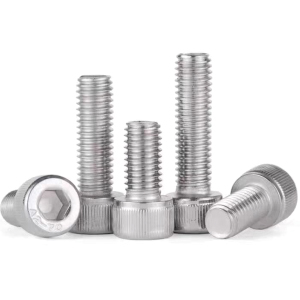
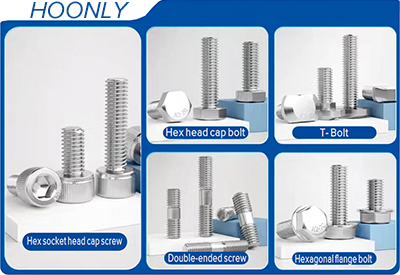
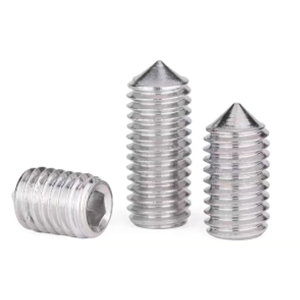
Stainless steel screw/bolt

Executive standard: GB/DIN/ISO
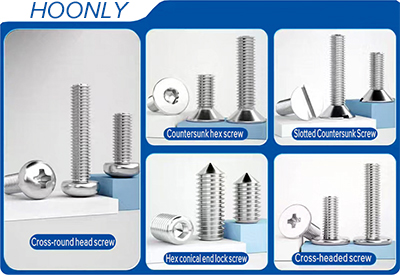
Category: Socket Set/Flat Head/Countersunk/Hex Head/Round Head/Truss Head

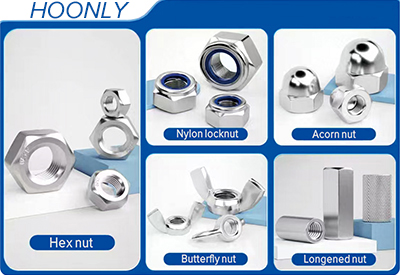
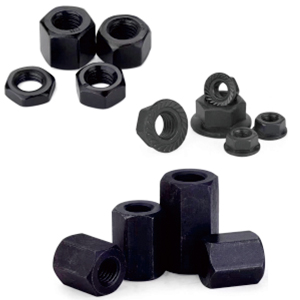
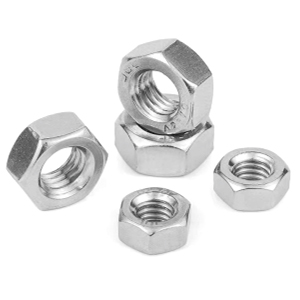
Stainless steel nut

Stainless steel nut

Executive standard: GB/DIN/ISO
Category: Hex Nut/Insert Lock Nut/Flange Nut/Slotted Nut/Wing Nut/Flat Head Nut/Weld Nut

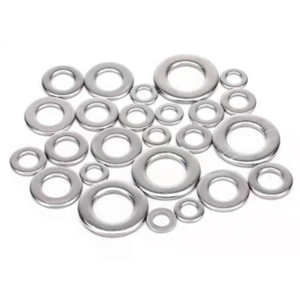
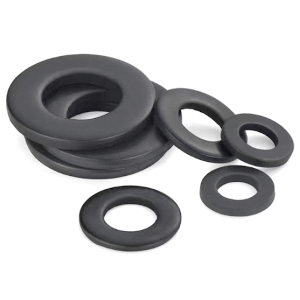
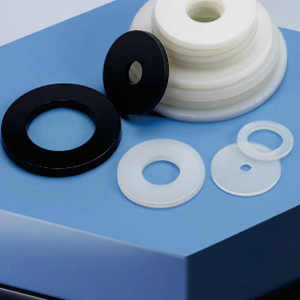
Stainless steel gasket or washer

Stainless steel washer

Executive standard: GB/DIN/
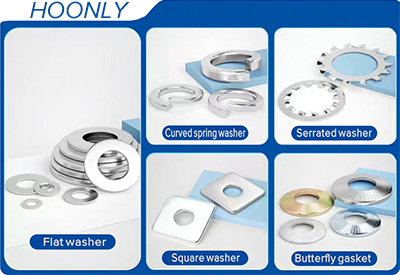
Category: Plain/Flat/Spring Washer/Serrated Washer/Curved Washer/Gasket

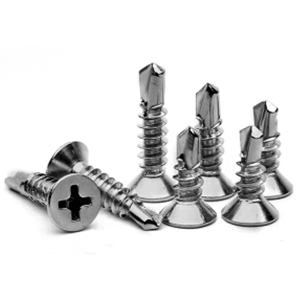
Stainless steel self-tapping screw

Stainless steel self-tapping

Executive standard: GB/DIN/
Category: Countersunk/Pan Head/Round/Oval Head/Hex/Truss Head

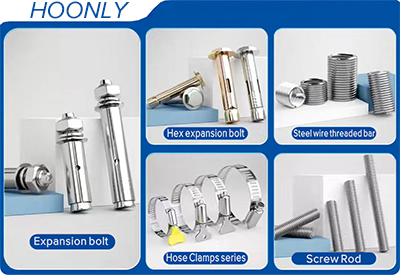
Stainless steel expansion bolt

Executive standard: GB/Factory
Category: Hex Head/Phillips Pan/Hex Socket Countersunk/Eye Bolt

Stainless steel rivet

Stainless steel rivet

Executive standard: GB/Factory
Category: Solid Rivet/Semi-Tubular/Hollow Rivet/Blind Rivet/Drive Rivet

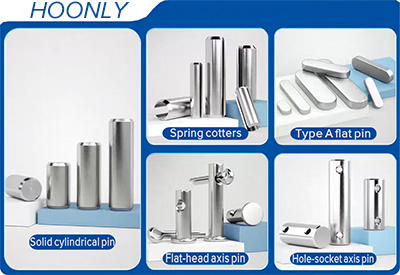
Stainless steel pin

Stainless steel pin

Executive standard: GB/Factory
Category: Cylindrical Pin/Taper Pin/Cotter Pin/Spring Pin/Locator Pin/Safety Pin

Stainless steel stopper screw

Stainless steel stopper screw

Executive standard: GB/DIN/ISO
Category: Cylindrical Pin/Taper Pin/Cotter Pin/Spring Pin/Locator Pin/Safety Pin

High-Tensile Series Fasteners

Providing the essential strength and durability to maximize structural integrity in critical assemblies across demanding industrial sectors.

Item-2-High-Tensile Series Fasteners

High Tensile Series Fastener

High-strength fasteners are primarily employed at critical connection positions in the construction industry, such as steel structure joints, steel component splicing, curtain wall fixings, and prefabricated component butt joints.

High-strength fasteners are mainly used in key connection points of mechanical equipment such as component splicing, bearing housing fixation, and transmission system component connections, forming friction-type or bearing-type reliable connections.

High-strength bolts are mainly used in key parts of bridges such as steel component joints, beam segment splicing, and connections between beams and piers/abutments.

High-strength fasteners are primarily utilized at critical connection points in the automotive industry, such as chassis frame joints, engine block-cylinder head junctions, transmission system component assemblies, and body structure splices.

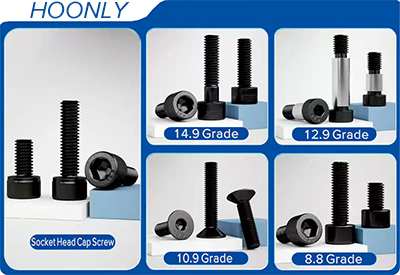
High-strength fastener materials primarily refer to steel grades rated 8.8, 10.9, and 12.9 under the EN ISO 898-1 standard. These steels exhibit exceptional mechanical strength—after specialized manufacturing processes such as spheroidizing annealing, cold forging, and quenching-tempering heat treatment, they can withstand extremely high torque loads, enabling reliable high-strength connections in critical structures.

The numerical grades encode key performance metrics: the first digit represents ultimate tensile strength (in 100MPa units), while the second denotes the ratio of yield strength to tensile strength. For instance, Grade 8.8 steel boasts a tensile strength of 800MPa and a yield strength of 640MPa (80% of tensile strength) .

Common materials for Grade 8.8 fasteners include 1035 steel and 1045 steel (corresponding to 35# and 45# steel in Chinese standards). Grades 10.9 and 12.9, classified as alloy steels, typically use materials like 40Cr (chromium steel) and 435 steel. These alloy steels incorporate elements such as chromium and molybdenum to enhance hardenability and mechanical performance.

Renowned for their superior load-bearing capacity and corrosion resistance—often enhanced through surface treatments including hot-dip galvanizing and Dacromet coating —these fasteners are widely adopted across high-demand industries.
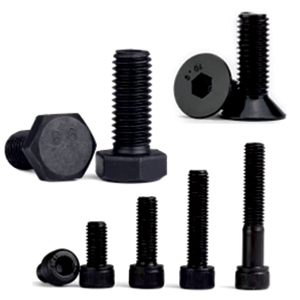
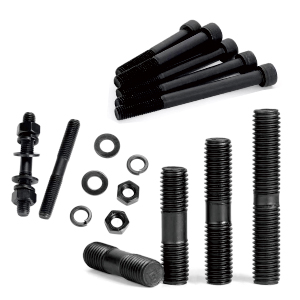
High-Strength Tensile Screws

High-Strength Bolts/Screws

Executive standard: GB/ISO/DIN
Featured external threads and is heat-treated to achieve superior tensile strength.

💡 Tip: For maximum joint reliability, always ensure that bolts, nuts, and washers are of matched performance grades.

High-Strength Tensile Bolts

High-Strength Stud Bolts

Executive standard: GB/ISO/DIN
Double-ended design for secure anchoring in flanged connections and other specific assemblies.

💡 Tip: For maximum joint reliability, always ensure that bolts, nuts, and washers are of matched performance grades.

High-Strength Tensile Nuts

High-Strength Nuts

Executive standard: GB/ISO/DIN
Engineered to match high-strength bolts, ensuring optimal thread engagement and connection integrity.

💡 Tip: For maximum joint reliability, always ensure that bolts, nuts, and washers are of matched performance grades.

High-Strength Tensile Washers

High-Strength Hardened Washers

Executive standard: GB/ISO/DIN
Provided high surface hardness to protect components, distribute pressure evenly, and prevent loosening.

💡 Tip: For maximum joint reliability, always ensure that bolts, nuts, and washers are of matched performance grades.

Self-Tapping Screws

Designed to tap threads directly into various materials like metal and plastic, ensuring a strong, permanent hold.

Item-3-Self-Tapping-Screws

Self Tapping Screws

Used for connecting and fixing wooden boards and timbers, such as the splicing of wooden house frames and the reinforcement of tenon-and-mortise structures in solid wood furniture. Ordinary self-tapping screws are used with pre-drilled holes.

Used for connecting thin metal sheets such as steel structures and home appliance casings (e.g., washing machine or refrigerator back panels). Self-drilling self-tapping screws are adopted to directly penetrate and fix the sheets without pre-drilling.

Used in the fixing of automotive interior plastic parts (e.g., instrument panel buckle bases) and plastic pipes. Self-extruding self-tapping screws are used to form threads by extruding plastic, preventing material cracking.

Used for fixing internal circuit boards and splicing casings of small home appliances (e.g., microwaves, coffee makers). Countersunk Phillips head self-tapping screws are mostly adopted to ensure a flat surface and easy tool operation.

Used for connecting ceiling keels with gypsum boards and fixing wall decorative panels. Large flat head self-tapping screws are used to increase the stress area for improved connection stability, and the heads can be hidden with decorative covers.

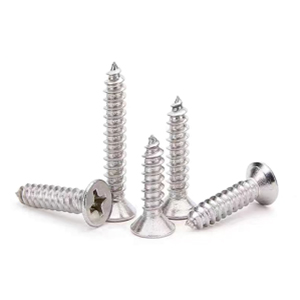
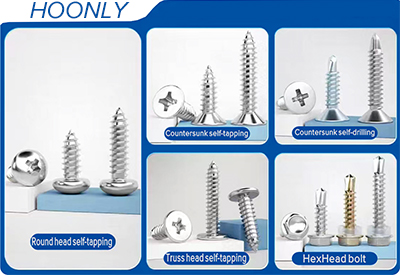
Self-tapping screws are a specialized type of fastener designed with a unique functionality: when driven into a material to be fastened, they utilize their own threads to tap, drill, extrude, and compress the material, creating a matching internal thread within it. This process enables the screw and the fastened material to form a tight, secure fit.

These screws typically feature a sharp, pointed tip, which allows them to easily penetrate and drive into the workpiece without the need for pre-drilling a pilot hole. It is this time-saving, pre-drill-free advantage that gives them their name—”self-tapping” screws.

Self-tapping screws are primarily used for connecting and securing relatively thin sheet materials. Common applications include joining color steel sheets together, as well as fastening color steel sheets to structural components like purlins and wall girders. Beyond sheet metal, they are also widely employed for joining and securing wood components.

There are several common types of self-tapping screws, such as wood screws, self-drilling screws, and standard self-tapping screws. These variants differ significantly in key aspects:

  • Hardness: Some are engineered for higher tensile strength to suit metal, while others are optimized for wood.
  • Thread Design: Thread pitch, depth, and shape vary to match different material densities (e.g., finer threads for wood, coarser or specialized threads for metal).
  • Intended Applications: Wood screws are tailored for timber connections,  self-drilling screws excel at penetrating thicker or harder sheet metals, and standard self-tapping screws are versatile for general thin-sheet fastening tasks.
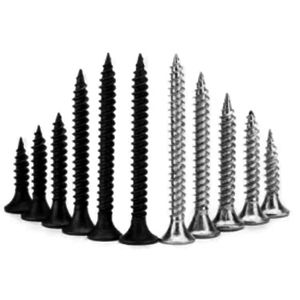
Self-Tapping Screws

Self-Tapping Screws

Executive standard: GB/ISO/DIN
Material: S.S304/S.S316/4.8 Grade Steel/Copper
Category: Round/Pan/Countersunk/Oval Countersunk/Truss Head

💡 Please select the appropriate self-tapping screws.

Self-Drilling-Screws

Self-Drilling Screws

Executive standard: GB/ISO/DIN
Material: S.S304/S.S410/4.8 Grade Steel
Category: Round/Pan/Countersunk/Truss Head

💡 Please select the appropriate self-tapping screws.

Expansion Bolt

Designed to tap threads directly into various materials like metal and plastic, ensuring a strong, permanent hold.

Item-4-Expansion Bolt

Expansion Bolt

Mounting heavy machinery or equipment bases: Used to permanently secure large industrial machinery, machine tools, or support frames to the concrete floor.

Securing steel structures to concrete. In construction, used to anchor the base plates of steel columns and beams to concrete foundations.

Installing guardrails and handrails. Used to fix the posts of metal or wooden guardrails for balconies, stairs, and corridors onto concrete floors or walls.

Suspending ceiling or pipe supports. Used to install threaded rods into concrete ceilings or slabs for suspending ductwork, pipes, cable trays, or ceiling support systems.

Anchoring facade scaffolding. During construction or exterior wall maintenance, used to securely fasten the anchor points of scaffolding to the building’s wall for enhanced stability.

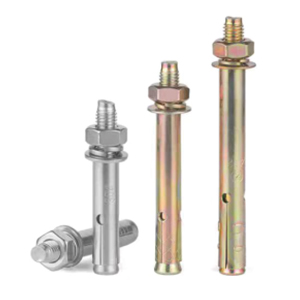
Expansion bolts are specialized threaded fasteners engineered to securely mount pipe supports, hangers, brackets, or various types of equipment onto solid surfaces such as walls, floor slabs, and columns. They are widely used in construction, mechanical installation, and infrastructure projects where reliable, load-bearing fixing is required.

The core securing principle of expansion bolts leverages a wedge-shaped taper to drive the expansion of key components, thereby generating strong frictional force between the fastener and the installation surface. This frictional force is what ensures long-term stability and prevents the bolt from loosening under load.

Typically, an expansion bolt assembly consists of two primary components:

  • Bolt shank: The main threaded rod, whose tail end is machined into a conical shape. A critical design feature is that the inner diameter of this conical section is larger than the inner diameter of the expansion sleeve.
  • Expansion sleeve: A cylindrical sleeve that fits around the conical tail of the bolt shank. It is made of durable materials (often metal or high-strength plastic) to withstand compression during installation.
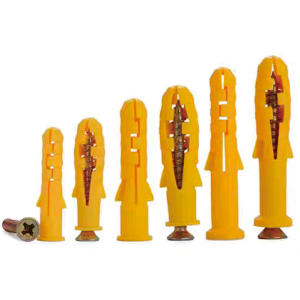
Plastic Expansion screws

Plastic Expansion screw

Executive standard: GB/Factory
Material: S.S304/4.8 or 8.8 Grade Steel/Nylon

Plastic expansion bolts, also known as plastic tube anchors or nylon expansion bolts, are commonly used for securing lightweight components such as door and window frames, curtain rails, and storage shelves in non-load-bearing materials.
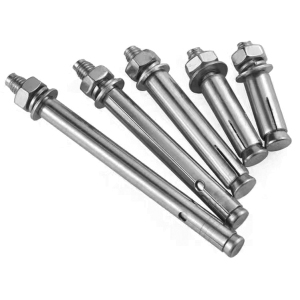
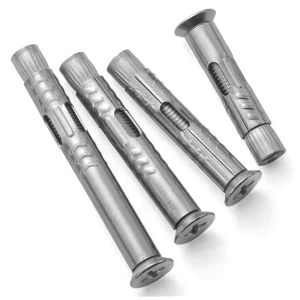
Sleeve-Type Expansion Bolt

Sleeve-Type Expansion Bolt

Executive standard: GB/Factory
Material: S.S304/4.8 or 8.8 Grade Steel/

The sleeve-type expansion bolt is the most common type, consisting of a bolt, a conical nut, and a sleeve. When the bolt is tightened, the conical nut is drawn into the sleeve, causing it to expand.

Internal Expansion Bolts

Internal Expansion Bolt

Executive standard: GB/Factory
Material: S.S304/4.8 or 8.8 Grade Steel/

Internal expansion bolts are installed by first hammering the sleeve into the pre-drilled hole. Then, a special installation tool and hammer are used to drive the internal expansion plug in, causing it to expand.
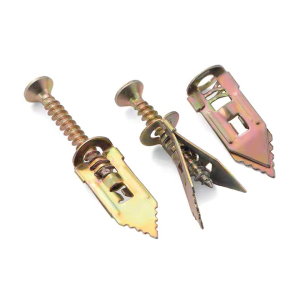
Hammer Drive Anchors

Hammer Drive Anchor

Executive standard: GB/Factory
Material: S.S304/4.8 or 8.8 Grade Steel/

Hammer Drive Anchors are the simplest to install, consisting of a threaded nail and a sleeve. Simply place it into the hole, then strike the top of the nail with a hammer, which will cause the sleeve to expand and secure in place.

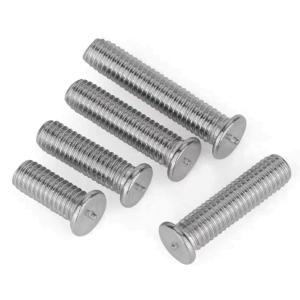
Welding And Riveting Screws

Durable solutions for permanent metal joining and assembly in manufacturing, construction, and electronics, providing strong, reliable, and vibration-resistant connections.

Welding-And-Riveting-Screws

Welding And Riveting Screws

Automotive Body Manufacturing: Used to join aluminum or high-strength steel body panels, providing high strength and fatigue resistance. They often serve as an alternative to traditional welding, particularly in multi-material body structures.

Electronics Enclosure: Press-riveted into thin metal enclosure panels or bases to serve as grounding studs or provide mounting points for internal PCBs and hard drive cages.

Heavy Equipment and Structural Frameworks: Welded onto large machinery, structural steel bridges, or building frameworks to create permanent and robust attachment points for auxiliary systems such as pipe clamps, cable trays, and access platforms.

Riveting is a process of joining two or more workpieces using rivets. This method features simple and cost-effective equipment, high joint strength, and excellent tightness. It provides reliable performance under impact loads, with minimal loosening and low deformation at the joint.

Press Riveting is a fastening technique commonly used to secure studs onto metal sheets—such as iron or aluminum plates—where welding is not suitable. It is also one of the most widely applied methods for permanent fixation. The process involves using a punch or hydraulic press to firmly install fasteners like rivet nuts, rivet screws, or studs into the workpiece. Components joined by press riveting exhibit superior surface quality, minimal deformation, and high connection strength.

Welding is a fabrication technique that joins metals or thermoplastic materials through the application of heat, high temperature, or pressure. Essentially, it enables mutual attraction and penetration between the filler material and the base metal, creating a permanent and robust bond via atomic-level diffusion and cohesion.
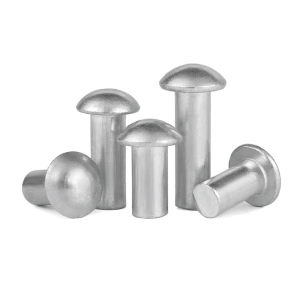
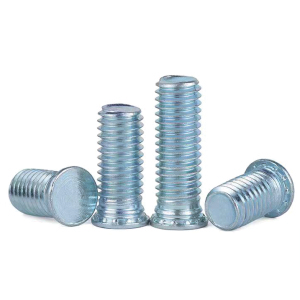
Riveting Screws

Riveting Screws

Executive standard: GB/Factory
Material: S.S304/Carbon steel galvanized/Aluminum/Copper

Riveted screws are mainly classified by the structure, installation method, and application scenario. Their core types include blind rivets, self-piercing rivets, pull rivets and so on.

Press Riveting Screws

Press Riveting Screws

Executive standard: GB/Factory
Material: S.S304/Carbon steel galvanized/Aluminum

Press-in rivets are mainly classified by structural function and application requirements. The common types include press-in rivet screws, press-in rivet nuts, press-in rivet studs, etc.

Welding Screws

Welding Screws

Executive standard: GB/Factory
Material: S.S304/Carbon steel/Aluminum/Zinc Alloy/PVC

Welded screws are mainly classified by welding methods. Different welding processes determine their structural design. Mainly includes resistance-welded screws, arc-welded screws.

Nylon Screws/Bolts & Nuts

Lightweight & non-conductive fasteners, ideal for electronics, automotive, and marine applications. Resistant to corrosion, chemicals, and abrasion for durable performance.

Item-6-Nylon Screws & Nuts

Nylon Screws & Nuts

Internal Fixing in Electronic Devices: Used for securing components around circuit boards in devices like routers and printers, avoiding metal conductivity risks.

Ideal for connecting food-contact parts due to their non-toxic and corrosion-resistant properties, meeting hygiene standards.

Outdoor Gardening Equipment: Applied in assembling garden sprinklers and outdoor flower stands, resisting corrosion caused by rain and dew.

Home Furniture Assembly: Served as connecting parts for wooden/plastic furniture like wardrobes and drawers, preventing rust and avoiding scratches on furniture surfaces.

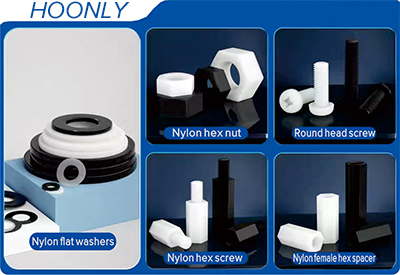
Nylon is a high-performance engineering plastic widely used to manufacture bolts and nuts, offering a reliable alternative to traditional metal fasteners such as copper and alloy components. Known for their excellent wear resistance, these nylon fasteners are ideal for applications that demand durability and reduced friction.

Key advantages include exceptional toughness, high tensile and flexural strength, and strong resistance to oil, shock, and vibration. Additionally, nylon bolts and nuts provide excellent electrical insulation, making them a safe choice for electrical and electronic equipment. Their low moisture absorption and superior dimensional stability ensure long-term performance without swelling or deformation, even in environments with frequent temperature or humidity changes.

Thanks to these properties, nylon bolts and nuts are widely used across various industries. They are commonly found in machinery, electronics, chemical processing, and construction—wherever a combination of strength, corrosion resistance, and electrical safety is required. Lightweight and non-conductive, they help reduce overall weight and prevent galvanic corrosion, extending the service life of assemblies.

Choose nylon bolts and nuts for efficient, insulating, and durable fastening in demanding applications.
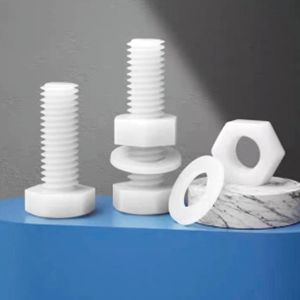
Nylon Bolts

Nylon Bolts

Executive standard: GB/Factory

Nylon bolts are lightweight, corrosion-free, and electrically insulating. They resist wear, oil, and vibration, making them ideal for use in machinery, electronics, and corrosive environments as reliable metal alternatives.

Nylon Nuts

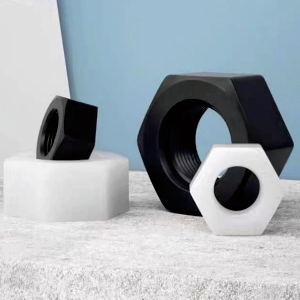
Nylon Nuts

Executive standard: GB/Factory

Nylon nuts offer excellent electrical insulation and corrosion resistance. Lightweight and durable, they are ideal for fastening in electronics, machinery, and moisture-rich environments.

Nylon Spacer

Nylon Spacer

Executive standard: GB/Factory

Nylon spacers provide reliable electrical insulation and corrosion resistance. They maintain precise component spacing, reduce vibration, and prevent short circuits in electronic and mechanical assemblies.

Get In Touch

Need to find fasteners, contact us

The above categories are primarily classified according to universal standards such as ISO, GB (China National Standards), and ANSI. While minor variations may exist across different standards—such as in dimensional tolerances or naming conventions—the core categories and their English nomenclature remain highly consistent.